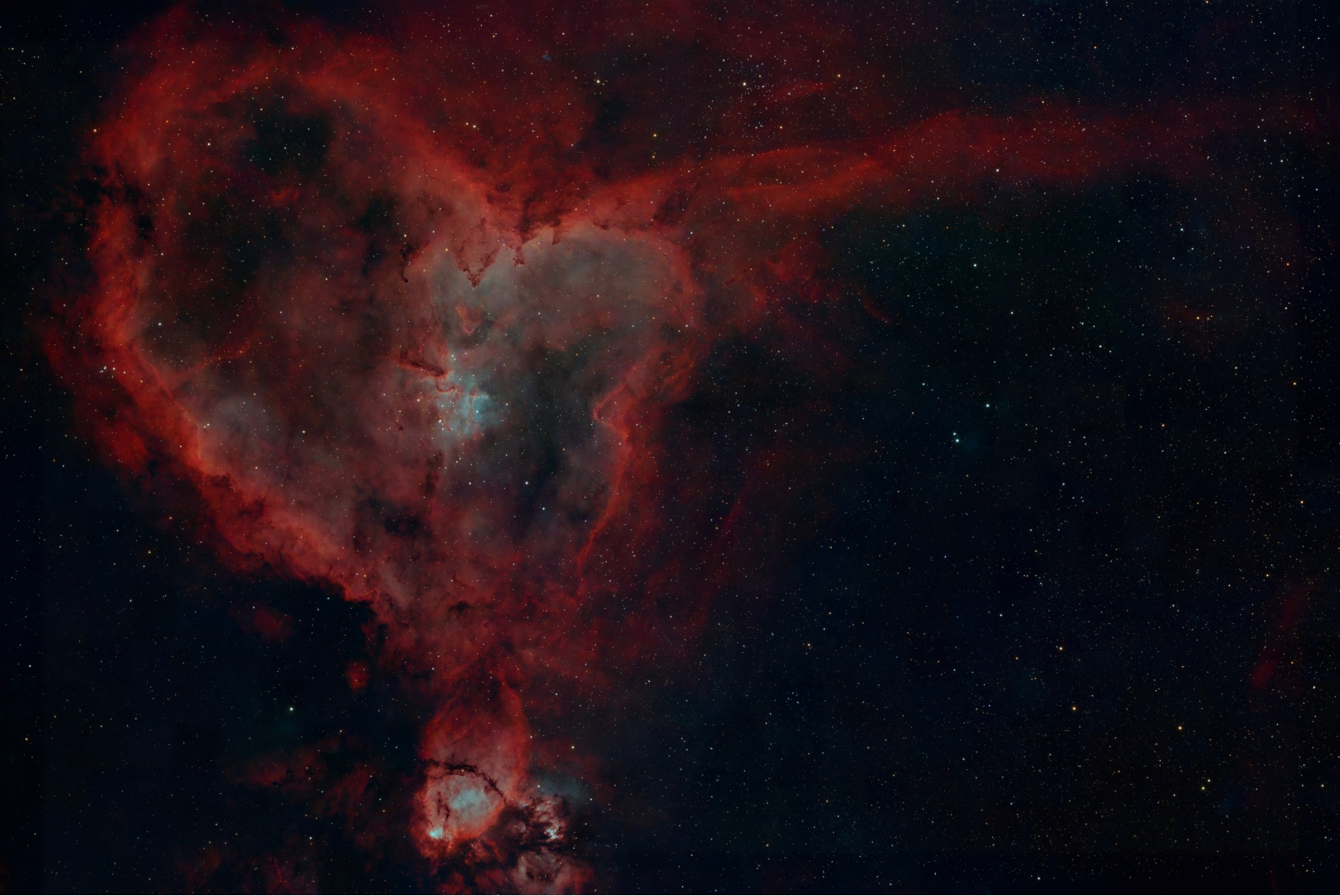
IC 1805 The Heart Nebula
Object
The Heart Nebula, also known as IC 1805, is a large emission nebula located approximately
7,500 light-
At the centre of the nebula is a young open star cluster called Melotte 15. The cluster
contains many hot, massive stars that are only a few million years old. These stars
produce enormous amounts of ultraviolet radiation and powerful stellar winds. The
radiation from these young stars ionizes the surrounding hydrogen gas, ultimately
resulting in photon emission by the mechanism mentioned, above. At the same time,
their stellar winds push against the surrounding material and gradually change the
shape of the nebula. The Heart Nebula is also an important star-
The formation of massive stars can influence the birth of other stars nearby. Radiation and stellar winds can compress surrounding clouds potentially triggering new episodes of star formation (RDI and Triggered star formation). However, these same processes can also disperse gas and prevent some clouds from forming stars.
Image
This image was taken on the nights of the 2nd and 3rd January, and 1st February 2026. The image was captured with an OSC camera and processed primarily in PixInsight with plugins. The details are as follows:
Location: Cork city, Ireland (Bortle 7).
Date: 2nd and 3rd January and 1st of February 2026.
Seeing: Poor to average.
Moon Phase: 2nd/3rd January, Waxing Gibbous 98-
Telescope: William Optics GT 81 Mk IV.
Barlow/Reducer: Willaim Optics Flat 6AIII 0.8X Flattener/Reducer.
Coma Corrector: N/A.
Other Optics: N/A.
Camera: ZWO ASi 2600 MC Pro
Filter 1: Optolong L-
Filter 2: Optolong Clear (for capturing RGB stars).
Controller: ZWO ASiair Pro
Guide Scope: William Optics M-
Guide Camera: ZWO Asi 120MM Mini Guide Camera.
Guiding Error: 1.24” to 0.56” RMS.
Mount: Sky Watcher EQ6-
Image Processing:
Application 1: Graxpert.
Application 2: Pleiades Astrophoto PixInsight & Plugins.
Application 3: RC Astro BlurXTerminator.
Application 4: RC Astro StarXTerminator.
Application 5: RC Astro NoiseXTerminator.
Image Capture:
Light Frames: 135 x 180 s.
Flat Frames: 90.
Dark Frames: 30 x 180 s.
Bias Frames: 30.
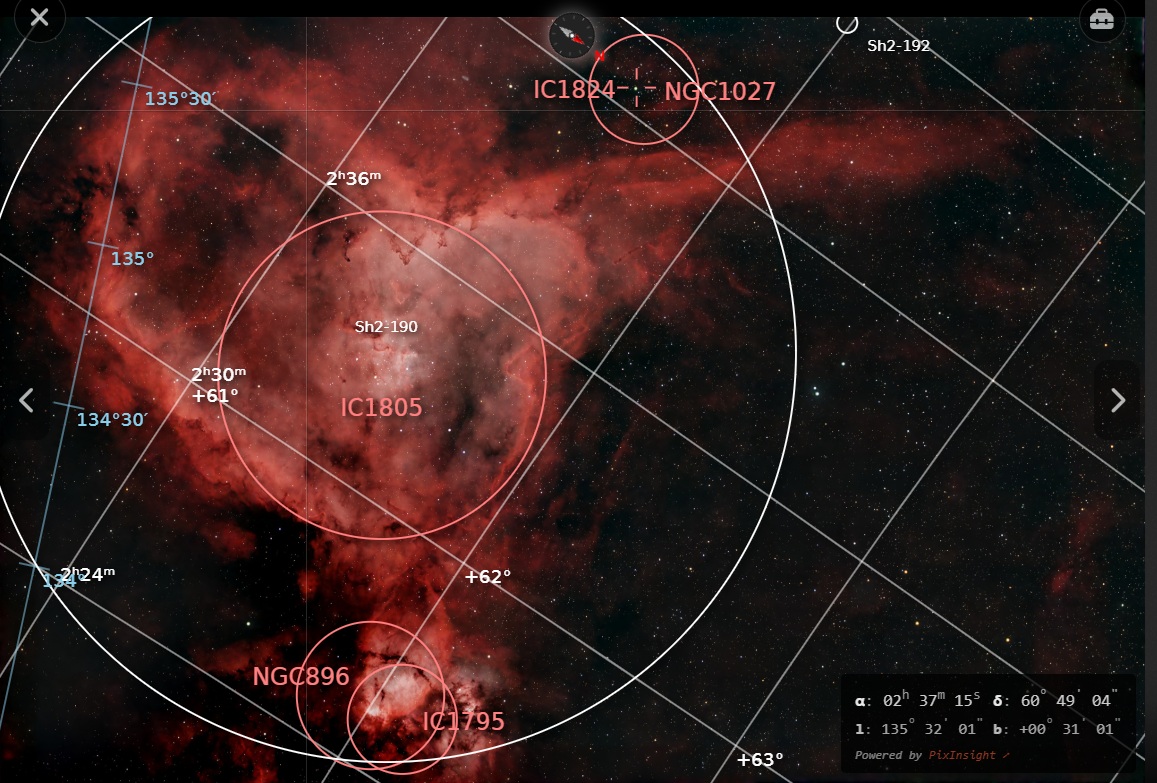
Location Annotated Image
History
The Heart Nebula was discovered by the German-
Physics
IC 1805 is one of the prominent star-
IC 1805 should not be regarded simply as an isolated cloud of glowing gas. Rather, it represents a complex astrophysical system comprising an H II region, a young stellar cluster, molecular material, ionized gas, dust, and numerous young stellar objects. The central stellar population is dominated by massive hot stars whose ultraviolet radiation supplies the energy required to maintain the ionization of the surrounding hydrogen. Their stellar winds also inject mechanical energy and momentum into the interstellar medium.
The region is particularly significant because it provides an observable example of stellar feedback. Massive stars simultaneously create the physical conditions necessary for the formation of an H II region while also altering the molecular material from which subsequent generations of stars may form.
Historical Identification and Nomenclature
IC 1805 is included in the Index Catalogue (IC) of deep-
Radio studies have demonstrated that the region contains a large ionized structure
whose morphology is strongly influenced by the massive stellar population. Spectroscopic
investigations have identified numerous O-
Galactic Location and Physical Environment
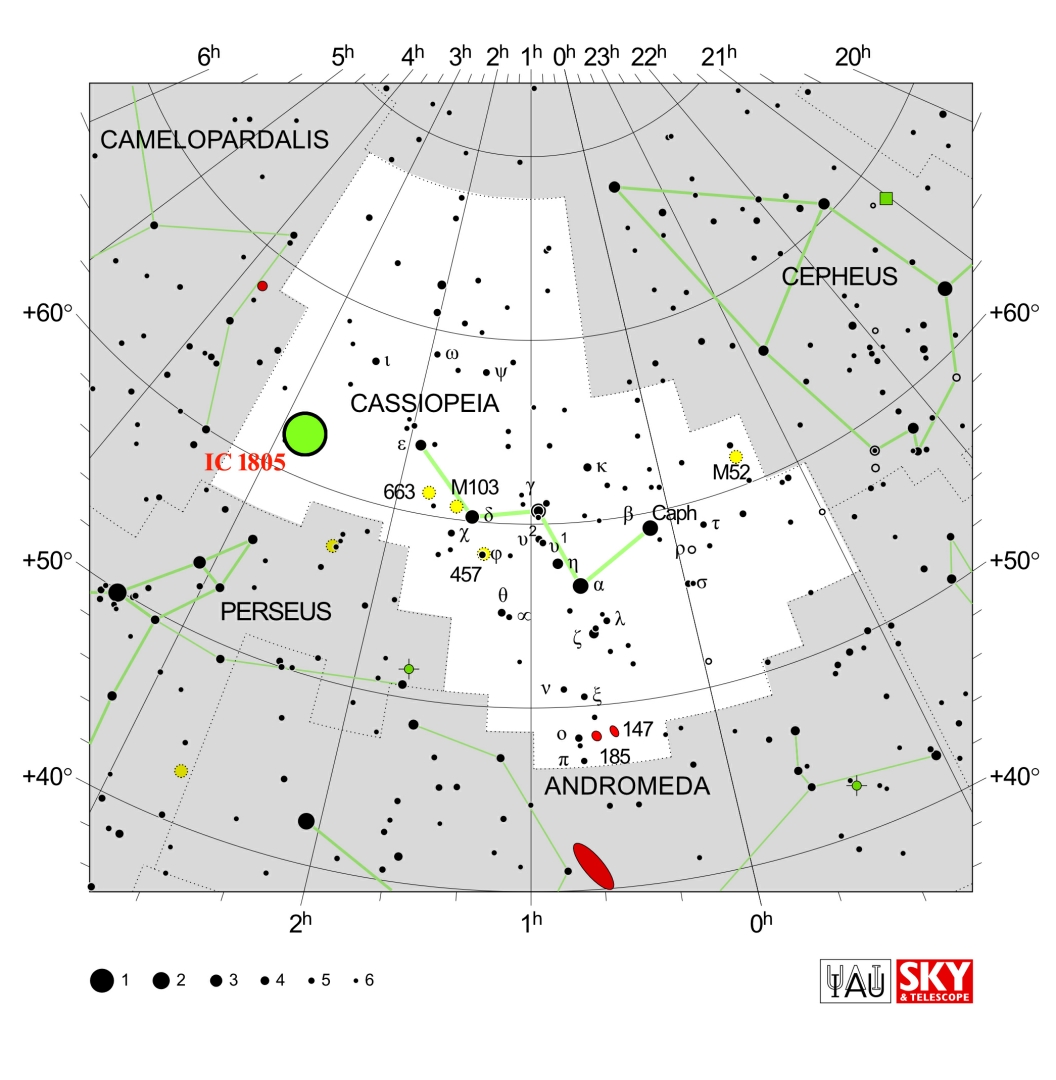
IC 1805 is located in the Perseus spiral arm, one of the major spiral structures
of the Milky Way. The region belongs to the broader Cas OB6 stellar association and
lies within the W3–W4–W5 complex, which contains several interacting molecular clouds,
H II regions, stellar clusters, and massive stars. Its approximate distance of 7,500
light-
The Young Open Cluster Melotte 15
At the centre of IC 1805 lies the young stellar cluster Melotte 15, which contains
the massive stars responsible for much of the nebula's ionization and dynamical evolution.
The cluster is extremely young on astronomical timescales, with age estimates generally
of order a few million years. Multiwavelength studies have found a young stellar
population with a mean age of approximately 2.5 Myr in one detailed investigation.
The presence of numerous O-
Formation of the H II Region
An H II region forms when sufficiently energetic ultraviolet photons ionize neutral hydrogen:
H + hv → H+ + e-
(Neutral hydrogen absorbs a photon and results in a hydrogen ion (a proton) and an ejected electron)
The principal source of these photons in IC 1805 is the population of young massive stars within Melotte 15.
Once ionized, the hydrogen plasma reaches temperatures of approximately:
Te ~ 104 °K
Electrons subsequently recombine with protons:
H+ + e-
(A hydrogen ion (a proton) recombines with an electron to form neutral hydrogen (H I) and emits a photon)
The emitted photons include characteristic hydrogen recombination lines, particularly Hα at 656.3 nm, which gives the nebula much of its characteristic red appearance in optical observations. The observed emission therefore results from a continual balance between photoionization by massive stars and radiative recombination within the nebular gas. In simplified form, the ionization equilibrium can be represented by:
Q(H0) = ꭍ ne np αB dv
(The magnitude of Q(H0) ultimately determines the luminosity of the gas cloud)
Where Q(H0) is the ionizing-
Stellar Winds and Nebular Morphology
Ionizing radiation is not the only mechanism shaping IC 1805. Massive stars also
generate powerful stellar winds, consisting of high-
Lw = ½ M vw2
(Not to be confused with photo-
where is M the mass-
Over several million years, the cumulative mechanical energy deposited by many massive
stars can become substantial. These winds excavate cavities in the surrounding molecular
material and drive expanding shells into the interstellar medium. Observational studies
of IC 1805 have associated the large-
Observational studies of IC 1805 have associated the large-
Ionized Gas, Dust and Molecular Clouds
IC 1805 contains several distinct phases of the interstellar medium. The ionized component produces optical emission, while neutral and molecular gas is detected at infrared and radio wavelengths. Dust associated with the molecular material absorbs visible light and produces the dark structures apparent in optical images. This multiphase structure can be represented schematically as:
molecular cloud → photodissociation region → H II region → stellar cluster
The interface between ionized and molecular material is particularly important. Ultraviolet radiation from massive stars can dissociate molecules and heat surrounding neutral gas, producing photodissociation regions (PDRs). Infrared observations are particularly effective at tracing these regions because warm dust and molecules emit strongly at infrared wavelengths. NASA observations using the WISE mission demonstrated that infrared observations can penetrate regions of dust obscuration and reveal structures associated with the early stages of star formation.
Ongoing Star Formation
Despite the disruptive effects of massive stars, IC 1805 remains associated with ongoing or relatively recent star formation. Multiwavelength observations have identified hundreds of candidate young stellar objects within the cluster environment. One detailed study identified 384 candidate young stellar objects, including Class I/II and Class III sources. The authors derived a mean age of approximately 2.5 Myr and concluded that the cluster probably formed within a large filamentary molecular cloud. The existence of very young objects alongside massive stars demonstrates that star formation in the region has not been a single instantaneous event. Instead, the cluster appears to contain a population with a range of evolutionary states.
The relationship between massive-
Stellar Feedback and the Evolution of the Interstellar Medium
Stellar feedback describes the transfer of energy, momentum and radiation from stars into their surrounding environment. In IC 1805, the principal feedback mechanisms are:
1. Ionizing radiation
2. Stellar winds
3. Radiation pressure
4. Supernova explosions in the later evolution of massive stars
The first two mechanisms are already active because the cluster contains young massive
stars. As the most massive members evolve, some may eventually undergo core-
Efeedback = Eradiation + Ewind + ESN
The first two terms dominate during the early stages of massive-
Multiwavelength Observations
IC 1805 cannot be adequately understood using visible-
Optical observations
Optical emission lines, particularly Hα, trace ionized hydrogen. Forbidden lines from elements such as oxygen, sulfur and nitrogen provide information about electron temperature, density, ionization conditions and excitation mechanisms. Spectroscopic observations can therefore distinguish between photoionized gas and regions affected by shocks associated with stellar winds.
Infrared observations
Infrared radiation penetrates dust more effectively than visible light and reveals
embedded young stellar objects, warm dust and molecular-
Radio Observations
Radio continuum emission traces ionized gas through thermal free–free emission. Radio observations are therefore important for determining the structure and physical properties of the W4 H II region.
X-
Young massive stars and young stellar objects can produce X-
Physical Significance of IC 1805
IC 1805 is important to stellar astrophysics for several reasons. First, its young
age means that many of its massive stars remain close to their formation environment.
Second, the region contains both massive stars and low-
Summary
The Heart Nebula illustrates the fundamental connection between stellar birth and the evolution of the interstellar medium. Massive stars are formed from dense molecular gas, but once they become sufficiently luminous they begin to transform the same environment from which they originated. The energy balance can be represented schematically as:
gravitational collapse → massive star formation → ionizing radiation + winds →
cloud compression/dispersal → subsequent star formation
This sequence should not be interpreted as a simple linear process. Feedback can
simultaneously stimulate and inhibit star formation depending upon local gas density,
geometry, radiation intensity and the relative orientation of molecular structures.
IC 1805 is therefore particularly useful for examining the self-
References
Lim, B., et al. (2020). “The Origin of a Distributed Stellar Population in the Star-
Panwar, N., et al. (2017). “Low-
Panwar, N., et al. (2019). “Understanding Formation of Young, Distributed Low-
Sung, H., et al. (2017). “An Optical and Infrared Photometric Study of the Young Open Cluster IC 1805 in the Giant H II Region W4.” The Astrophysical Journal Supplement Series, 230. Preprint
NASA. “IC 1805: The Heart Nebula.” Astronomy Picture of the Day. NASA Science