M 51 or the Whirlpool Galaxy
Object
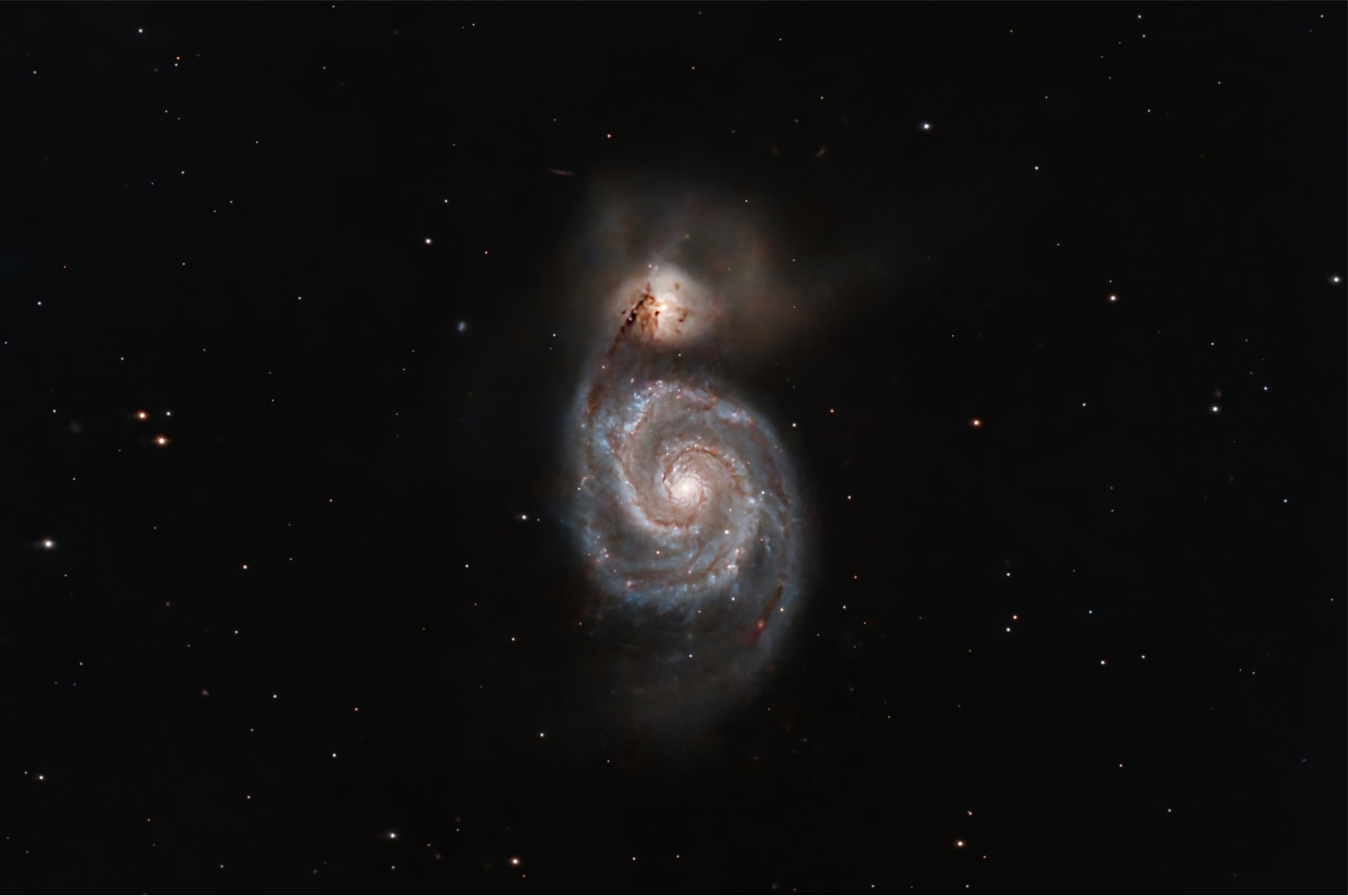
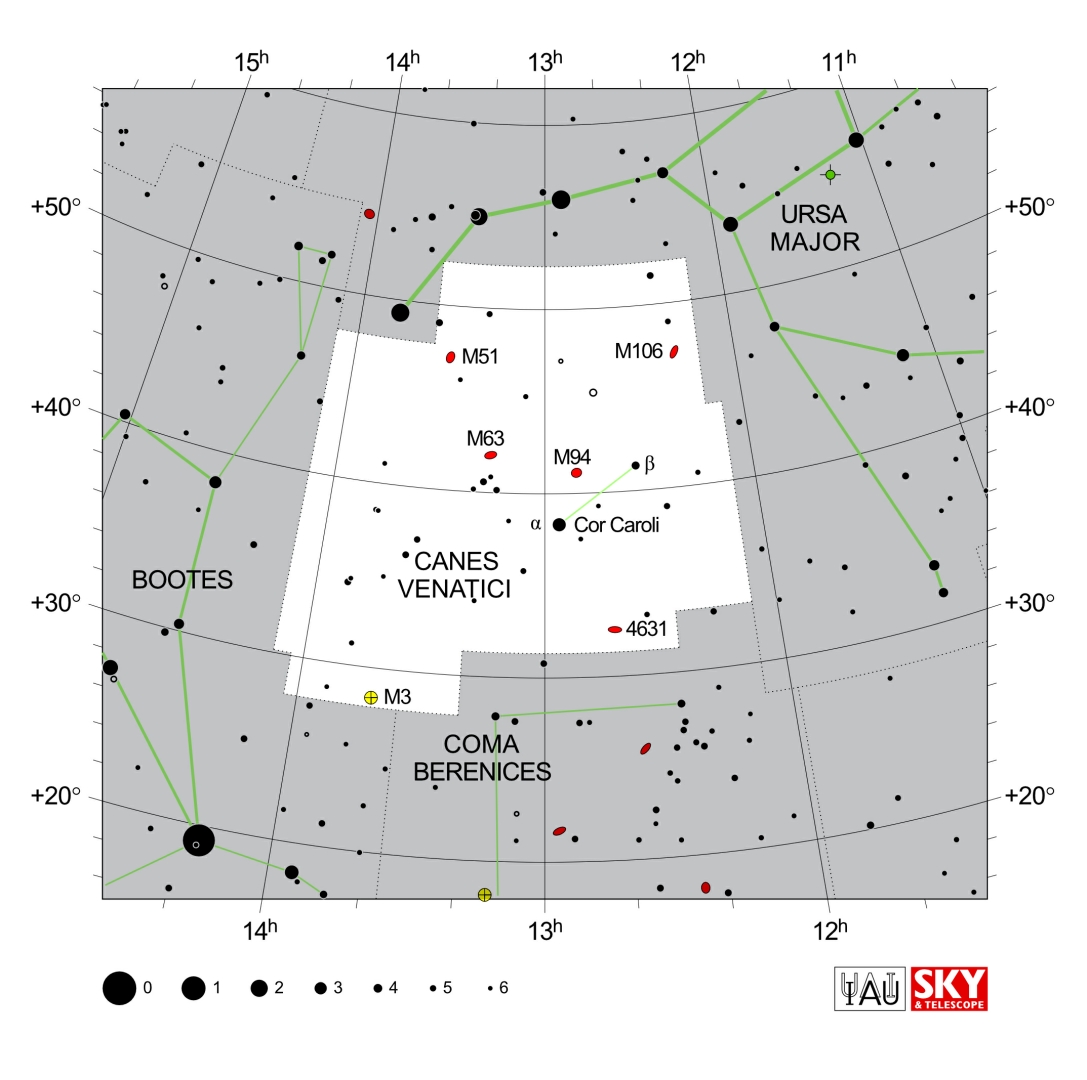
Messier 51 (M51), commonly known as the Whirlpool Galaxy, is a prominent interacting
spiral galaxy system located approximately 23 million light-
The distinctive appearance of M51 is largely caused by gravitational interactions
between its two galaxies. As NGC 5195 passes near or interacts with NGC 5194, gravitational
forces disturb the larger galaxy's disk and help compress gas within its spiral arms.
This compression can trigger enhanced star formation, making M51 a candidate for
investigating how galaxy interactions influence stellar evolution. M51 has been extensively
observed across the electromagnetic spectrum, from radio waves to X-
Image
This image was taken over the nights of the 19th of November 2025. The image was captured with an OSC camera and processed primarily in PixInsight with plugins. The details are as follows:
Location: Cork city, Ireland (Bortle 7).
Date: 8th June 2025.
Seeing: Poor to average.
Moon Phase: Waxing Gibbous, 93%.
Telescope: Sky Watcher N150/750 PDS Newtonian Reflector.
Barlow/Reducer: Willaim Optics Flat 6AIII 0.8X Flattener/Reducer.
Coma Corrector: N/A.
Other Optics: N/A.
Camera: ZWO ASi 2600 MC Pro
Filter 1: Optolong L-
Filter 2: N/A..
Controller: ZWO ASiair Pro
Guide Scope: William Optics M-
Guide Camera: ZWO Asi 120MM Mini Guide Camera.
Guiding Error: 0.56” RMS.
Mount: Sky Watcher EQ6-
Image Processing:
Application 1: Graxpert.
Application 2: Pleiades Astrophoto PixInsight & Plugins.
Application 3: RC Astro BlurXTerminator.
Application 4: RC Astro StarXTerminator.
Application 5: RC Astro NoiseXTerminator.
Image Capture:
Light Frames: 79 x 180 s.
Flat Frames: 60.
Dark Frames: 30 x 180 s.
Bias Frames: 30.
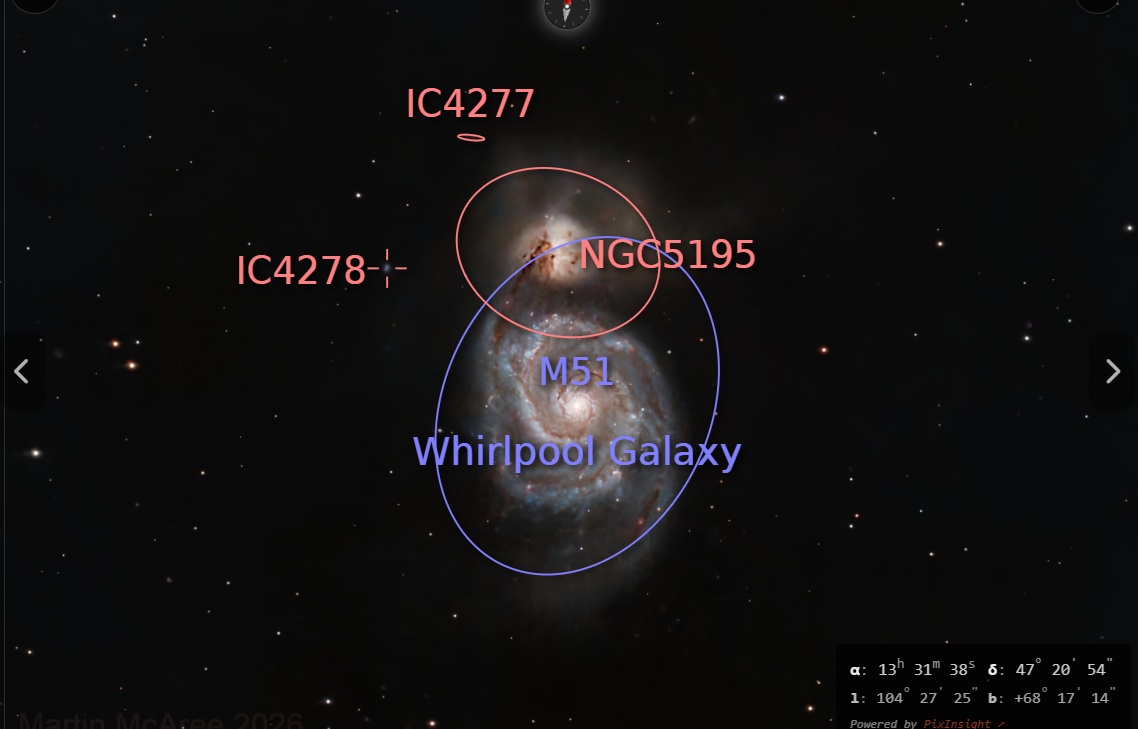
Location Annotated Image
History
The history of M51, commonly known as the Whirlpool Galaxy, is closely associated with the development of modern observational astronomy and the study of interacting galaxies. M51 was discovered by the French astronomer Charles Messier on 13 October 1773, while searching for objects that could be mistaken for comets. Messier originally catalogued the brighter component, now designated NGC 5194, as M51; its companion galaxy, NGC 5195, was later incorporated into the same system. In 1845, the English astronomer William Parsons, 3rd Earl of Rosse, observed M51 with the large reflecting telescope at Birr Castle and identified its prominent spiral structure, making it one of the earliest galaxies recognized as having a spiral form. During the nineteenth and early twentieth centuries, M51 became an important object in the debate over the nature of spiral nebulae and whether such systems were independent stellar galaxies beyond the Milky Way. Modern observations have established that M51 is a gravitationally interacting galaxy system in which the spiral galaxy NGC 5194 is undergoing strong tidal interaction with NGC 5195. This interaction has contributed to the development and enhancement of M51's spiral structure and has influenced the distribution of molecular gas and regions of active star formation.
Physics
M51 is a nearby interacting galaxy system consisting of NGC 5194, commonly designated M51a, and NGC 5195, or M51b. The prominent spiral structure of NGC 5194 makes the system particularly valuable for studying the connection between gravitational interactions and galactic morphology. Hydrodynamical simulations demonstrate that interaction with its companion can reproduce important features of the main galaxy’s spiral pattern. Dobbs et al. (2010). The scientific importance of M51 extends beyond its visible appearance. Observations can resolve the distribution of molecular gas on scales comparable to individual giant molecular clouds, allowing researchers to connect galactic structure with the material from which stars form. The PdBI Arcsecond Whirlpool Survey, or PAWS, established a detailed observational basis for investigating these relationships. Schinnerer et al. (2013)
This paper reviews selected observational and theoretical studies rather than presenting new measurements. Its central question is how the interaction, internal gas dynamics, and local gravitational conditions jointly influence star formation. The equations below provide a framework for interpreting the literature; illustrative calculations are distinguished from published observational results.
Distance and Physical Scale
Distance is essential for converting angular dimensions and observed fluxes into physical sizes and luminosities. McQuinn et al. obtained a distance of 8.58 ± 0.10 megaparsecs using the tip of the red giant branch method. The quoted uncertainty is statistical and should not be interpreted as a complete accounting of systematic error. McQuinn et al. (2016). A later analysis obtained 7.59 ± 0.30 megaparsecs from Cepheid variables and 7.34 ± 0.39 megaparsecs from modeling the Type IIP supernova SN 2005cs. Combining these independent estimates yielded 7.50 ± 0.24 megaparsecs, significantly below the earlier red giant branch result. This discrepancy highlights the need to compare independent distance indicators. Csörnyei et al. (2023). The distance modulus is expressed as:
μ = m − M = 5 log₁₀(D / 10 pc)
Here, μ is the distance modulus, m is extinction-
ℓ ≈ Dθ
Here, ℓ is physical size and θ is measured in radians. Consequently, one arcsecond corresponds to approximately 36.4 parsecs at 7.50 megaparsecs or 41.6 parsecs at 8.58 megaparsecs. Luminosity depends more strongly on distance:
L = 4πD²F
In this expression, F is the measured energy flux and L is the corresponding isotropic luminosity. For the same observed flux, adopting 8.58 instead of 7.50 megaparsecs increases the inferred luminosity by approximately 31%. This is a calculated consequence of the two distance choices, not a newly measured property of M51. Comparisons between published studies must therefore account for their adopted distances.
Tidal Interaction and Spiral Structure
The companion’s gravity exerts different accelerations across the disk of NGC 5194.
Such differential forcing can perturb stellar orbits and gas flows, producing large-
a_tidal ≈ 2GM_cR / r³
Here, G is the gravitational constant, M_c is the companion’s mass, R is displacement
within the affected galaxy, and r is the separation between the galaxies. This expression
describes the leading tidal term along the separation direction when R is much smaller
than r. It is a conceptual approximation; reconstructing M51 requires extended mass
distributions and a time-
Numerical models by Dobbs et al. reproduced substantial aspects of M51’s spiral morphology,
including kinks and arm bifurcations. Their simulations did not support a single
global spiral pattern speed and instead favored an evolving tidal pattern. These
results challenge the application of a simple, steady spiral-
Ω(R) = v_c(R) / R
Here, Ω is the circular orbital angular frequency and v_c is circular speed. A spiral pattern may rotate at a different angular frequency, Ω_p. In an evolving, tidally disturbed disk, assuming that Ω_p remains constant across all radii can conceal important dynamical complexity.
Molecular Gas and Star Formation
PAWS mapped the central region of M51 in carbon monoxide emission at a reported resolution of approximately 40 parsecs. Its comparisons of molecular gas with other tracers revealed complex spatial relationships: molecular emission and star formation indicators can coincide, appear offset, or lack a clear local association. These findings show why a bright molecular structure cannot automatically be identified with an equally strong site of current star formation. Schinnerer et al. (2013). Molecular gas mass is commonly inferred through:
M_mol = α_CO L′_CO
Here, L′_CO is the CO line luminosity in K km s⁻¹ pc², and α_CO is the conversion factor in M⊙ per K km s⁻¹ pc². The gas mass convention must specify whether helium is included. Uncertainty in α_CO propagates directly into inferred gas masses and star formation efficiencies. The empirical relationship between gas and star formation surface densities is often written:
Σ_SFR = A(Σ_gas)ᴺ
Here, Σ_SFR is the star formation rate per unit area, Σ_gas is gas mass per unit area, A is a normalization, and N is the fitted slope.
Kennicutt et al. investigated this relationship in M51 over scales of approximately 0.5–2 kiloparsecs. They reported slopes ranging from 1.37 to 1.56, depending on spatial sampling. Star formation correlated strongly with molecular gas, whereas the corresponding relationship with atomic gas was weak. Their results demonstrate that the measured scaling law depends partly on observational scale and sampling strategy. Kennicutt et al. (2007). Another useful quantity is the molecular gas depletion time:
τ_dep = M_mol / SFR
Equivalently, for measurements over the same area:
τ_dep = Σ_mol / Σ_SFR
A shorter depletion time indicates a higher present star formation rate per unit molecular mass. It does not predict when a galaxy will exhaust its gas, because inflow, outflow, stellar recycling, and changing activity can alter both terms.
Dynamical Regulation of Cloud Collapse
Gas density is only one factor governing star formation. Meidt et al. found that
strong streaming motions in M51 are associated with molecular clouds whose star formation
is suppressed relative to clouds in other environments. They proposed that dynamical
pressure effects reduce cloud confinement and inhibit collapse. This provides a physical
interpretation for regional variations in depletion time. Meidt et al. (2013). For
a uniform, pressureless sphere, the gravitational free-
t_ff = √[3π / (32Gρ)]
Here, ρ is mean volume density. Higher density reduces the idealized collapse time, but real clouds also experience turbulence, magnetic forces, external pressure, and galactic shear. A common star formation parametrization is:
SFR = ε_ff M_mol / t_ff
The dimensionless quantity ε_ff represents the fraction of gas converted into stars
per free-
α_vir = 5σ²R_c / (GM_c)
Here, σ is the one-
Nuclear Activity
X-
λ_Edd = L_bol / L_Edd
For ionized hydrogen under electron-
L_Edd = 4πGM_BH m_p c / σ_T
Here, M_BH is black hole mass, m_p is proton mass, c is the speed of light, and σ_T is the Thomson scattering cross section. The weak nuclear activity suggests that a galactic encounter alone is insufficient to determine instantaneous black hole growth. Gas must also lose angular momentum and reach the central accretion region, processes whose timing need not match the strongest visible tidal disturbance.
Reference
Brightman, M., et al. (2018). A long hard-
Csörnyei, G., et al. (2023). Reeling in the Whirlpool galaxy: Distance to M51 clarified through Cepheids and the type IIP supernova 2005cs.
Dobbs, C. L., Theis, C., Pringle, J. E., & Bate, M. R. (2010). Simulations of the grand design galaxy M51: A case study for analysing tidally induced spiral structure.
Kennicutt, R. C., Jr., et al. (2007). Star formation in NGC 5194 (M51a). II. The spatially resolved star formation law.
Leroy, A. K., et al. (2017). Cloud scale ISM structure and star formation in M51.
McQuinn, K. B. W., et al. (2016). The distance to M51.
Meidt, S. E., et al. (2013). Gas kinematics on GMC scales in M51 with PAWS: Cloud stabilization through dynamical pressure.
Schinnerer, E., et al. (2013). The PdBI Arcsecond Whirlpool Survey (PAWS). I. A cloud-