

Post-
Low-
The expelled envelope is enriched in heavy elements synthesized during stellar evolution
and may be carbon-
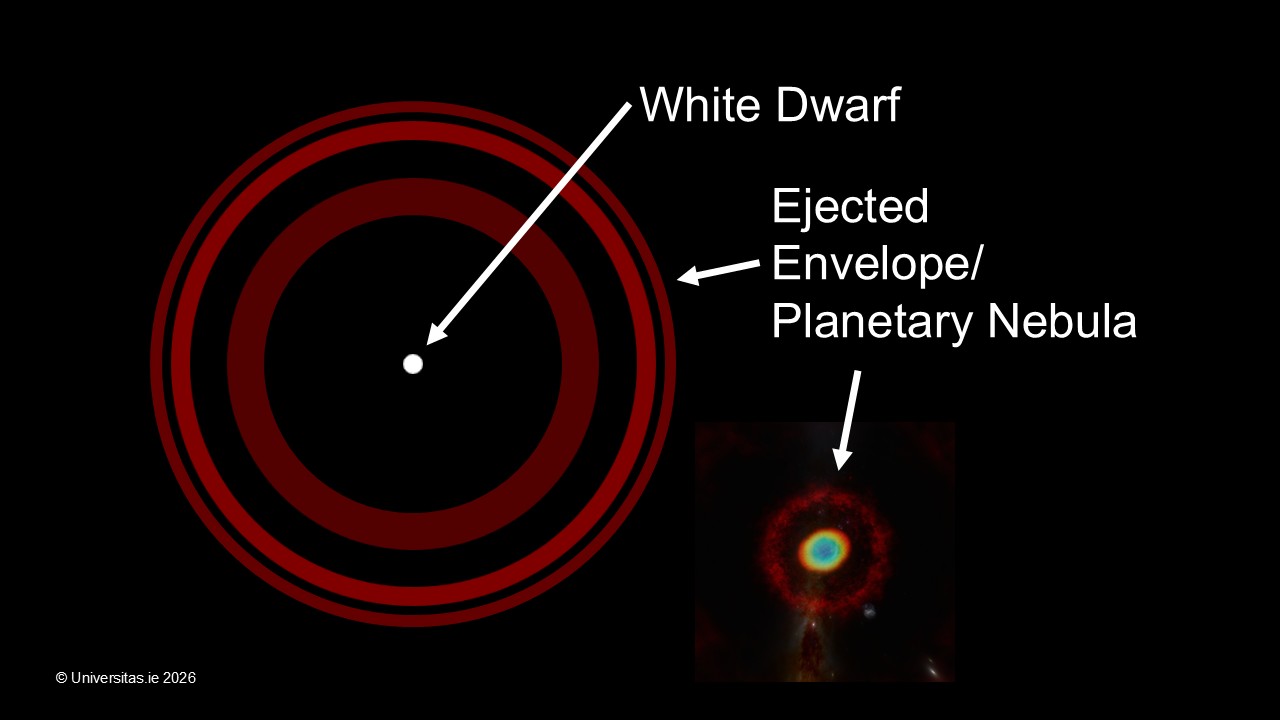
In rare cases, late or very late thermal pulses occur after the star has left the
AGB, producing born-
White dwarfs represent the final evolutionary stage of low-
During early cooling stages, energy loss is dominated by photon radiation, while at later stages neutrino emission and crystallization of the degenerate core contribute significantly. As crystallization proceeds, latent heat is released, temporarily slowing the cooling rate. Ultimately, a white dwarf becomes a cold, dark remnant known as a black dwarf, although the Universe is not yet old enough for any to exist.
Large Mass Stars:
In massive stars, the core mass at the onset of hydrogen-
Very massive stars, particularly at approximately solar metallicity and with initial
masses above roughly 40 solar masses are sufficiently luminous that radiation-
The core of a massive star, defined as the hydrogen-
The precise mass threshold for complete carbon burning depends on factors including
metallicity, rotation, and mass loss, but lies approximately in the range of 7–10
solar masses After carbon burning is completed, the core mass grows to roughly 2–3
solar masses and reaches temperatures sufficient for further nuclear burning. Neon
burning follows as temperatures rise, and in stars with initial masses of approximately
8–12 solar masses, electron capture on neon and magnesium can destabilize the core,
potentially leading to an electron-
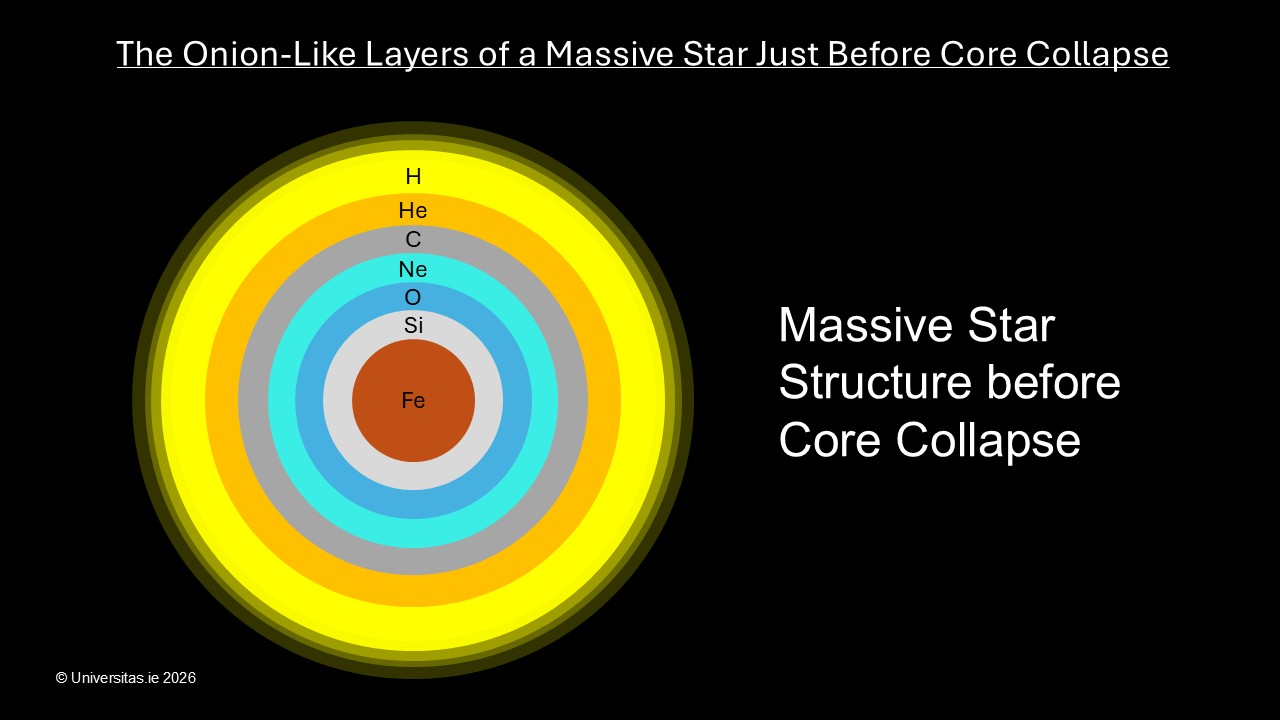
In more massive stars, neon burning proceeds stably, followed by oxygen and silicon
burning. These processes produce an iron-
Supernovas
The collapse of the core of a massive star results in the formation of a neutron star or, if the core mass exceeds the Tolman–Oppenheimer–Volkoff limit, a black hole. During this collapse, a large fraction of the gravitational potential energy is released, primarily in the form of neutrinos. Through mechanisms that remain incompletely understood, a portion of this energy is transferred to the surrounding stellar material, giving rise to a Type II, Type Ib, or Type Ic supernova.
The core-
While red giant stars can synthesize heavy elements via neutron-
The energy transferred from the collapsing core not only drives nucleosynthesis but
also accelerates the newly synthesized material beyond the stellar escape velocity,
producing the observed supernova explosion. Despite substantial progress, current
numerical models of Type II, Ib, and Ic supernovae do not yet account for sufficient
energy transfer to fully reproduce observed explosion energies. Neutrino oscillations
may play an important role in this process by redistributing energy among neutrino
flavors and through additional general-
Observational evidence from the masses and orbital parameters of binary neutron-
For a star of 1 solar mass, the resulting white dwarf is of about 0.6 solar mass, compressed into approximately the volume of the Earth. White dwarfs are stable because the inward pull of gravity is balanced by the degeneracy pressure of the star's electrons, a consequence of the Pauli exclusion principle. Electron degeneracy pressure provides a rather soft limit against further compression; therefore, for a given chemical composition, white dwarfs of higher mass have a smaller volume. With no fuel left to burn, the star radiates its remaining heat into space for billions of years.
White and Black Dwarfs
A newly formed white dwarf is characterized by extremely high temperatures, with
surface temperatures exceeding 100,000 K and substantially higher temperatures in
its interior. During the first years of its evolution, a significant fraction of
its energy is lost through neutrino emission. Over timescales of order years, the
white dwarf radiates away most of its residual thermal energy and undergoes long-
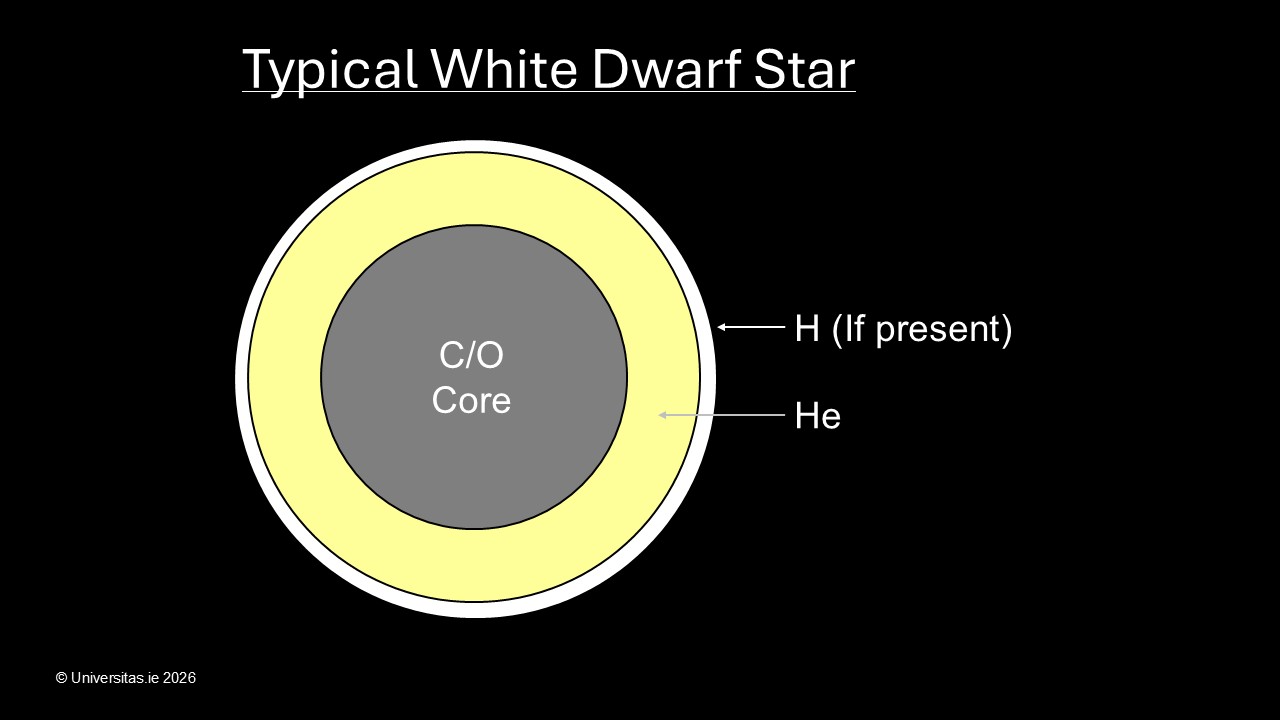
The composition of a white dwarf is determined primarily by the initial mass of its
progenitor star. Progenitors with initial masses of approximately 8-
As cooling continues, white dwarfs asymptotically approach a cold, non-
If the mass of a white dwarf exceeds the Chandrasekhar limit, approximately 1.4 solar
masses for compositions dominated by carbon, oxygen, neon, and/or magnesium, electron
degeneracy pressure can no longer support the star as electron capture reduces the
number of pressure-
The Chandrasekhar instability implies that stable white dwarfs cannot exist above approximately 1.4 solar masses, with possible minor exceptions for rapidly rotating white dwarfs in which centrifugal support partially offsets gravity. In binary systems, mass transfer from a companion star can drive an initially stable white dwarf beyond this limit.
In close binary systems where a white dwarf accretes hydrogen-
Neutron Stats and Black Holes.
During the collapse of a massive stellar core, increasing density and pressure drive
electron capture reactions in which electrons combine with protons to form neutrons
and neutrinos. The resulting loss of electron degeneracy pressure allows the core
to contract into an extremely dense state dominated by neutron-
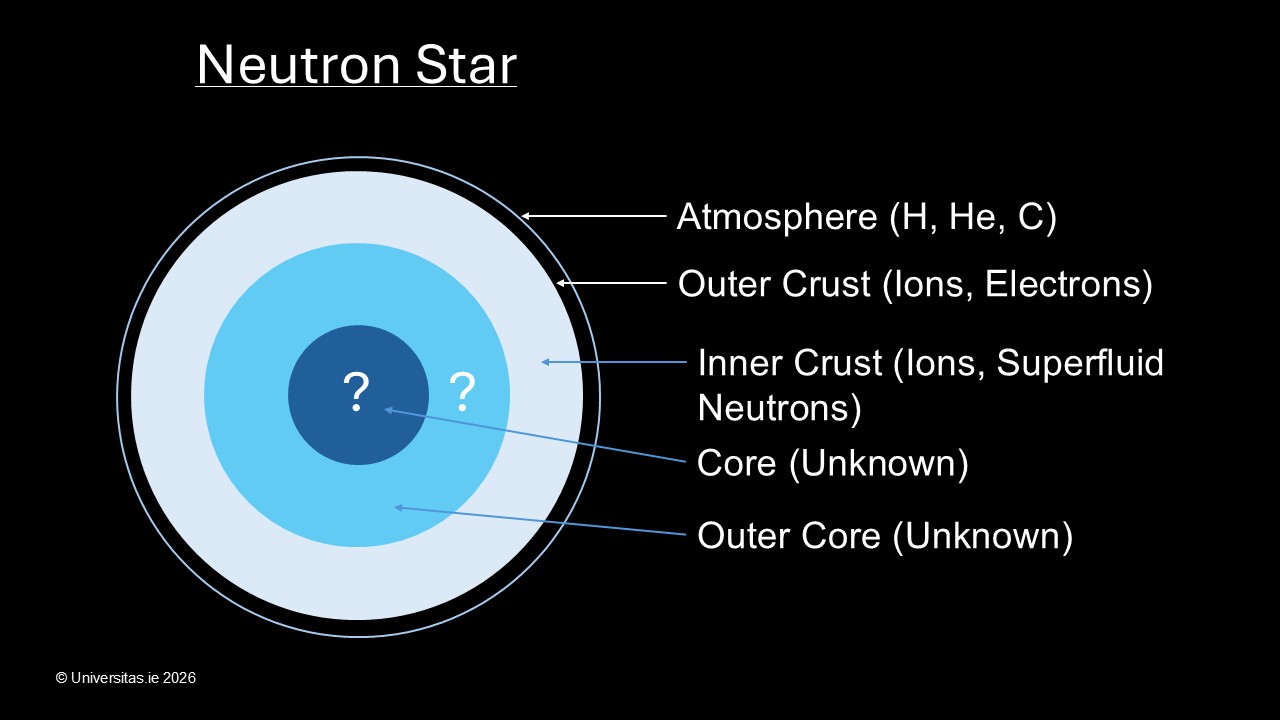
Neutron stars are highly compact objects with typical radii of order 10 km and mean
densities comparable to or exceeding nuclear density. Conservation of angular momentum
during collapse leads to rapid rotation, with observed spin periods ranging from
milliseconds to several seconds. Neutron stars also possess intense magnetic fields.
When the magnetic axis is misaligned with the rotation axis, collimated beams of
electromagnetic radiation are produced; if these beams intersect the Earth, periodic
pulses are observed at the stellar rotation period. Neutron stars exhibiting such
pulsed emission are classified as pulsars. Although pulsar emission is most commonly
detected at radio wavelengths, pulsars have been observed across the electromagnetic
spectrum, including optical, X-
If the mass of the collapsing remnant exceeds the maximum mass supportable by neutron
degeneracy pressure, continued gravitational collapse is unavoidable. In this case,
the remnant contracts beyond its Schwarzschild radius and forms a black hole. The
precise value of the maximum neutron-
Black holes are a direct prediction of general relativity. In classical general relativity,
the event horizon constitutes a causal boundary from which neither matter nor information
can escape to an external observer, although quantum-
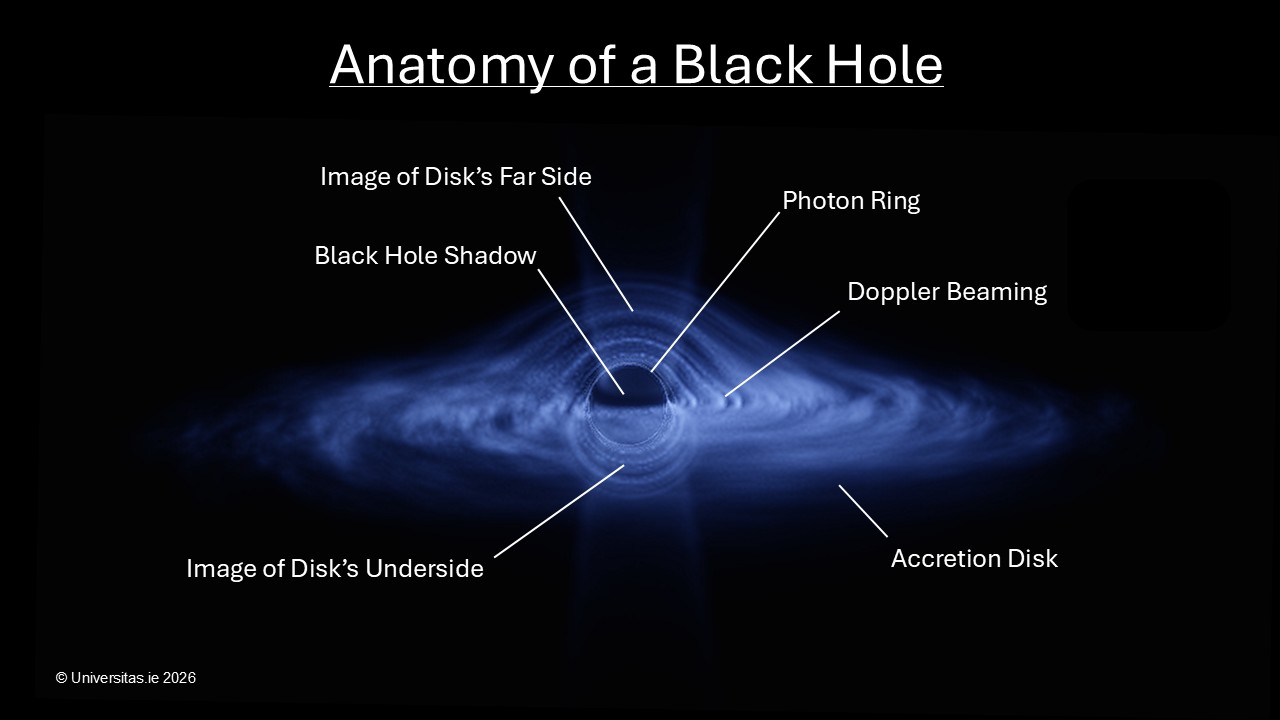
Despite substantial progress, the detailed mechanisms linking stellar core collapse to the formation of neutron stars or black holes remain incompletely understood. It is not yet established whether some massive stars collapse directly into black holes without producing an observable supernova, or whether certain supernovae initially form unstable or metastable neutron stars that subsequently collapse into black holes. The relationship between the initial mass and composition of a star and the nature of its final compact remnant therefore remains an active area of research.
Summary
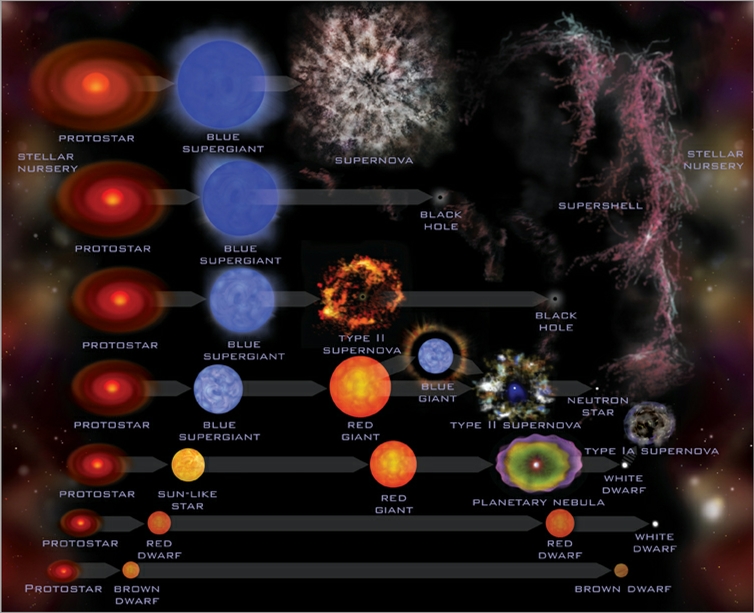
The image below, taken from NASA’s chandra.si.edu, summarises the typical stellar lifecycles by star mass.
References.
J. B. Kaler “Stellar evolution”, McGraw Hill, 2020.
Henny J.G.L.M. Lamers and Emily M. Levesque “Understanding Stellar Evolution”, IOPscience, 2017.
Stellar Evolution, MIT Press, 1972.
Degl’Innocenti Scilla, “Introduction to stellar evolution”, Journal of Physics: Conference Series, Volume 703, 8th European Summer School on Experimental Nuclear Astrophysics (Santa Tecla School) 13–20 September 2015, Santa Tecla, Italy.
D. M. Bowman, J. van Saders and J. S. Vink “The Structure and Evolution of Stars: Introductory Remarks”, MDPI 2023.
S. Kumar Kalaiselvi and Victoria Choi, Understanding the Importance of Stellar Birth and Evolution for a Comprehensive Understanding of the Sun and Other Stars
Harvard and Smithsonian Centre for Astrophysics: Stellar Structure and Evolution.
Harvard University Stellar Evolution – Cosmic Cycles of Formation and Destruction
Beccari, Giacomo ; Carraro, Giovanni “Introduction to the Theory of Stellar Evolution”
Ecology of Blue Straggler Stars. Astrophysics and Space Science Library, Volume 413.
ISBN 978-
Cohen, Martin. In Darkness Born: The Study of Star Formation. New York: Cambridge University Press, 1988.
Genet, Russell M., Donald S. Hayes, Douglas S. Hall, and David R. Genet. Supernova 1987a: Astronomy’s Explosive Enigma. Mesa, Ariz.: Fairborn Press, 1988.
Schneider, Stephen E., and Thomas T. Arny. Pathways to Astronomy. 2d ed. New York:
McGraw-
E. E. Salpeter, S. W. Stahler, Berkeley, J. Najita, E. Churchwell, B. G. Elmegreen,
J. Liebert, J. Andersen, Y. Lebreton, J. N. Bahcall, T. M. Brown, A. Maeder, P. P.
Eggleton, C. A. Pilachowski, R. -
S. Grossman “Double-
L. Fulmer, R. Hainich, H. Todt, A. C. Sander, John S. Gallagher, V. Ramachandran,
T. Shenar, Wolf-
Diriba Gonfa Tolasa, “Stellar Evolution and Nucleosynthesis: Investigating the Life Cycles of Massive Stars and Their Role in Galactic Chemical Enrichment”, Engineering Physics (Volume 8, Issue 1), 2025.
Konstanze Zwintz, “The Power of Asteroseismology for Early Stellar Evolution”, Front.
Astron. Space Sci., 13 December 2019 Sec. Stellar and Solar Physics Volume 6 -