

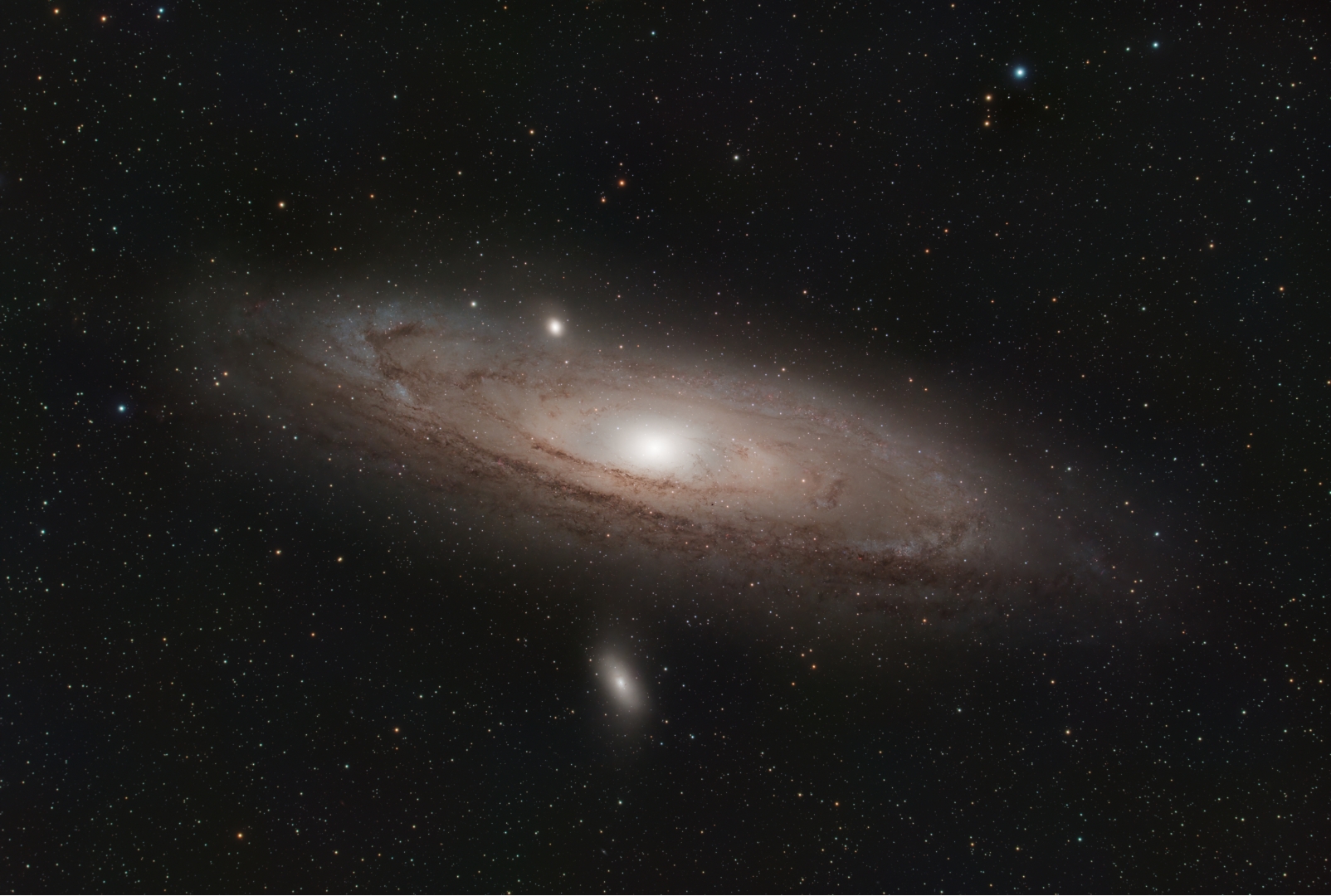
M 31 or The Andromeda Nebula.
Object
The Andromeda Galaxy (M31) is the nearest large spiral galaxy to the Milky Way and
a major object of study in galactic astronomy. Located approximately 2.5 million
light-
The galaxy has a prominent central bulge, a disk containing gas and dust, and an
extended stellar halo. Its mass is estimated to be of the order of solar masses when
its dark-
M31 contains both old and young stellar populations. Star formation occurs primarily within its disk, although its overall rate is relatively low compared with that of some other spiral galaxies. Its halo contains numerous ancient stars and globular clusters, providing evidence of its long and dynamically active history.
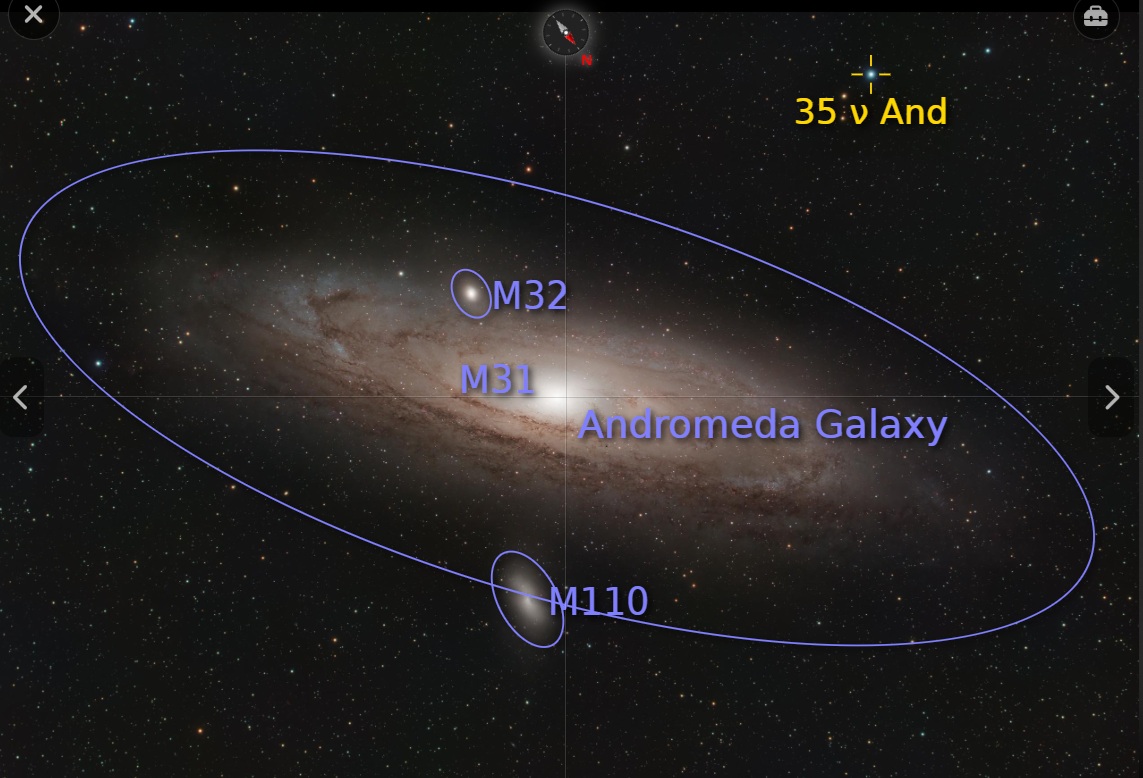
The galaxy is surrounded by numerous dwarf satellite galaxies, including M32 and M110. Their motions and stellar populations help astronomers investigate the distribution of dark matter and the processes by which large galaxies grow through mergers and accretion. Stellar streams observed around M31 are particularly important evidence of disrupted satellite galaxies.
M31 and the Milky Way are the two dominant galaxies of the Local Group. Their mutual gravitational attraction will eventually lead to a major interaction. Current models indicate that the galaxies are likely to merge over several billion years, although the precise timescale and outcome depend on their relative motion and the distribution of dark matter.
Image
This image was taken over the nights of the 19th, 20th and 21st of November 2025. The image was captured with an OSC camera and processed primarily in PixInsight with plugins. The details are as follows:
Location: Cork city, Ireland (Bortle 7).
Date: 19th, 20th & 21st of November 2025.
Seeing: Poor to average.
Moon Phase: New Moon.
Telescope: William Optics GT 81 Mk IV.
Barlow/Reducer: Willaim Optics Flat 6AIII 0.8X Flattener/Reducer.
Coma Corrector: N/A.
Other Optics: N/A.
Camera: ZWO ASi 2600 MC Pro
Filter 1: Optolong L-
Filter 2: N/A.
Controller: ZWO ASiair Pro
Guide Scope: William Optics M-
Guide Camera: ZWO Asi 120MM Mini Guide Camera.
Guiding Error: 1.24” to 0.56” RMS.
Mount: Sky Watcher EQ6-
Image Processing:
Application 1: Graxpert.
Application 2: Pleiades Astrophoto PixInsight & Plugins.
Application 3: RC Astro BlurXTerminator.
Application 4: RC Astro StarXTerminator.
Application 5: RC Astro NoiseXTerminator.
Image Capture:
Light Frames: 106 x 180 s.
Flat Frames: 60.
Dark Frames: 30 x 180 s.
Bias Frames: 30.
Location Annotated Image
History
The earliest surviving written description is generally associated with the Persian
astronomer Abd al-
During the eighteenth century, astronomers began systematically cataloguing nebulae. Charles Messier included Andromeda in his famous catalogue in 1764, giving it the designation M31. For much of the nineteenth century, M31 was classified as a nebula rather than a galaxy. Astronomers could observe its extended structure but did not yet know whether it was a relatively nearby cloud of gas and stars within the Milky Way or a completely separate stellar system.
Improvements in telescopes and photography revealed increasingly complex structures
within M31, including its spiral form and numerous individual stars. A major question
in early twentieth-
The decisive evidence came from observations by Edwin Hubble. Using the 100-
Physics
M31 is the dominant large galaxy of the Andromeda subgroup and, together with the Milky Way and the Triangulum Galaxy (M33), defines the dynamical core of the Local Group. Its proximity allows telescopes to resolve individual stars across much of the disc and halo while also measuring the integrated properties normally used to study more distant galaxies. This dual observational perspective makes M31 unusually valuable: population histories inferred from colour–magnitude diagrams can be compared directly with global measurements of luminosity, rotation, gas, dust, and chemical abundance.
Historically, M31 also occupies a central place in the development of extragalactic astronomy. The object was known as a diffuse nebula for centuries, but Edwin Hubble’s identification of Cepheid variables in the 1920s established that it lay far beyond the Milky Way. The result helped resolve the debate over whether spiral nebulae were external galaxies. Modern observations have transformed M31 from a symbol of the extragalactic distance scale into a spatially resolved record of disc growth, satellite accretion, and environmental evolution.
Fundamental Properties
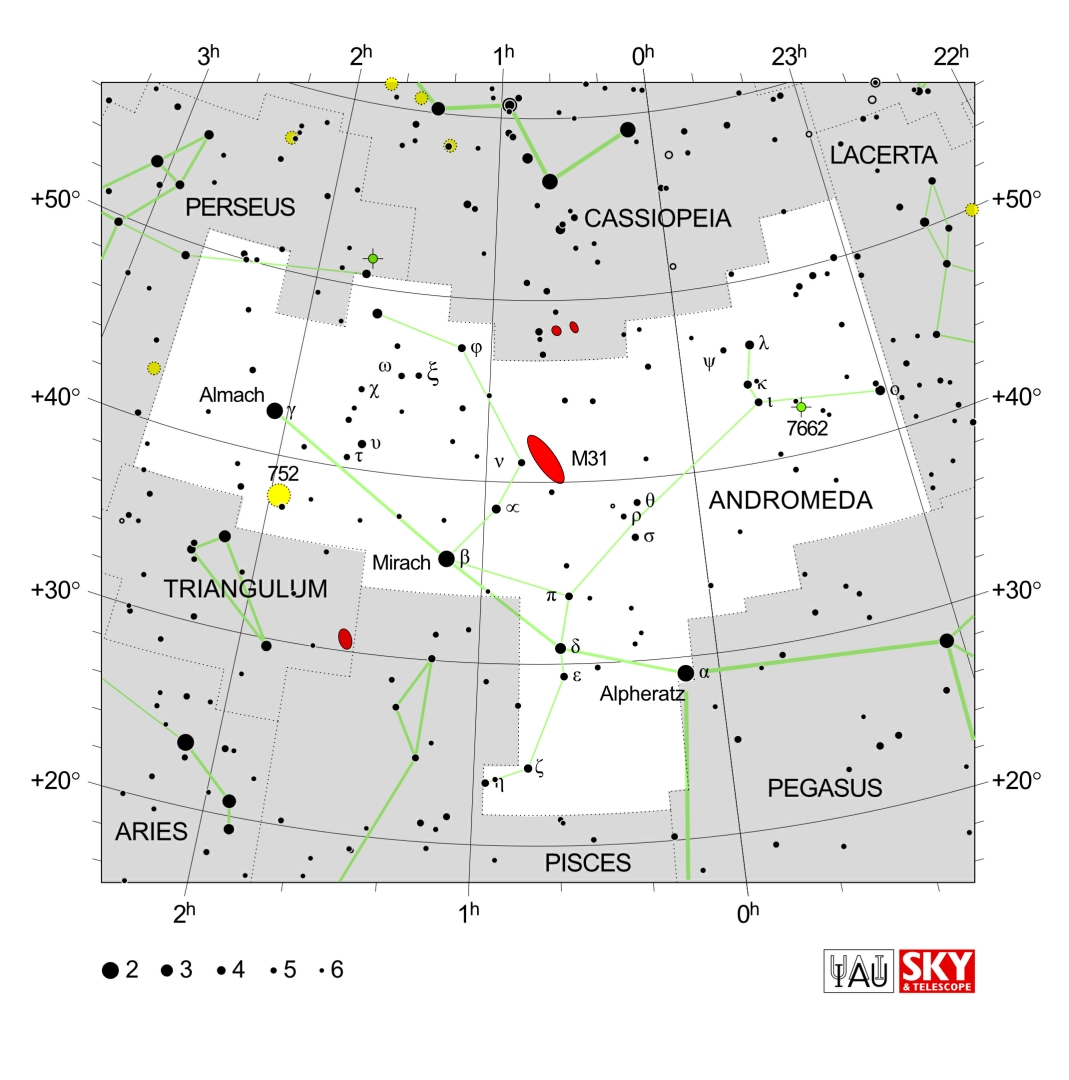
M31 is located in the constellation Andromeda at right ascension about 00h 42m 44s
and declination about +41° 16′. A commonly adopted distance is 785 ± 25 kpc, equivalent
to about 2.56 million light-
Table 1. Selected properties of M31. Values are representative rather than exact constants.
Morphology and Structural Components
Disc and Spiral Structure
The stellar disc of M31 is dynamically and morphologically complex. Dust lanes trace
spiral structure, but the high inclination and prominent star-
Bulge and Nucleus
M31 has a large, metal-
Halo and Satellite System
M31’s stellar halo extends far beyond the bright disc and is not smooth. The Giant
Stellar Stream, shelves, and numerous lower-
The galaxy is accompanied by several dozen known satellites, including M32 and NGC
205. Satellite counts are observationally incomplete at very low luminosities, and
membership must be established using distance and velocity measurements. Some satellites
occupy a thin, coherently rotating configuration, although the longevity and cosmological
significance of such planes remain debated. The system provides an important test
of small-
Stellar Populations and Star Formation
Resolved-
The best-
Chemical enrichment varies across the system. Young disc populations and H II regions
are relatively metal rich, whereas many halo stars and globular clusters are more
metal poor. However, the halo also contains metal-
Interstellar Medium and Multiwavelength Emission
M31 contains atomic hydrogen, molecular clouds, ionized gas, and dust, but its cold-
X-
Dynamics Dark Matter and Total Mass
The kinematics of gas, stars, globular clusters, planetary nebulae, satellites, and tidal streams constrain M31’s gravitational potential over different radial ranges. Within the optical disc, rotation measures the combined force of baryons and dark matter. At larger radii, the velocities of halo tracers and satellites provide leverage on the virial mass, but the result depends on orbital anisotropy, equilibrium assumptions, tracer selection, and the adopted halo profile. Consequently, published mass estimates span a substantial range rather than defining one exact value.
A representative contemporary value is M200 ≈ 1.3 ± 0.4 × 10¹² M☉, where M200 denotes the mass inside a radius whose mean density is 200 times the critical density (Sawala et al., 2025). This uncertainty is scientifically important. It affects the inferred orbit of M33, the timing argument for the Local Group, the interpretation of satellite dynamics, and predictions for the future Milky Way – M31 encounter.
Assembly and Interaction History
M31 is not an undisturbed classical spiral. Streams, shells, a thick disc, age–velocity
relations, and spatial variations in stellar populations indicate repeated gravitational
interactions. The Giant Stellar Stream is the clearest signature of a comparatively
recent accretion event; orbital models relate it to other inner-
Interactions may also have influenced the disc. M32 and NGC 205 are obvious candidates
for perturbing M31, while M33’s orbit links the evolution of the two major members
of the Andromeda subgroup. Nevertheless, assigning a particular ring, warp, or burst
of star formation to a unique perturber is difficult because different orbital histories
can produce similar present-
Future Evolution within the Local Group
M31 is approaching the Milky Way along the line of sight, a fact that led to the widely repeated prediction of an inevitable merger in roughly 4–5 billion years. That statement is now too definite. The future orbit depends sensitively on small transverse motions, the extended mass distributions of both galaxies, dynamical friction, and the gravitational influence of M33 and the Large Magellanic Cloud.
Using updated Hubble and Gaia constraints and Monte Carlo propagation of observational uncertainties, Sawala et al. (2025) found that the full Milky Way – M31 – M33 – LMC system has only a little over a 50% probability of a Milky Way – M31 merger within 10 billion years. M33 increases the merger probability, whereas the LMC decreases it by shifting the Milky Way’s motion. Among simulated systems that do merge, the median merger time is about 7.6 billion years under the authors’ fiducial definition. The appropriate conclusion is therefore probabilistic: a future merger remains plausible, but a distant flyby or continued separation is also compatible with current data.
If a merger occurs, gravitational tides would rearrange the discs, trigger phase
mixing, and build a more spheroidal remnant. Direct stellar collisions would remain
exceedingly rare because interstellar separations are enormous. Gas compression could
temporarily enhance star formation, but the final level of activity would depend
on how much cold gas remains. The nuclei and their black holes would ultimately sink
toward the remnant centre through dynamical friction and, on smaller scales, form
a bound black-
Scientific Importance and Outstanding Questions
M31 links near-
Important uncertainties remain. The total halo mass and three-
References
Bender, R., et al. (2005). HST STIS spectroscopy of the triple nucleus of M31: Two nested disks in Keplerian rotation around a supermassive black hole. The Astrophysical Journal, 631, 280–300. https://doi.org/10.1086/432434
Corbelli, E., Lorenzoni, S., Walterbos, R., Braun, R., & Thilker, D. (2010). A wide-
Dalcanton, J. J., et al. (2012). The Panchromatic Hubble Andromeda Treasury. The
Astrophysical Journal Supplement Series, 200, 18. https://doi.org/10.1088/0067-
Ibata, R., Irwin, M., Lewis, G., Ferguson, A. M. N., & Tanvir, N. (2001). A giant
stream of metal-
McConnachie, A. W., et al. (2005). Distances and metallicities for 17 Local Group
galaxies. Monthly Notices of the Royal Astronomical Society, 356, 979–997. https://doi.org/10.1111/j.1365-
McConnachie, A. W. (2012). The observed properties of dwarf galaxies in and around
the Local Group. The Astronomical Journal, 144, 4. https://doi.org/10.1088/0004-
Sawala, T., Delhomelle, J., Deason, A. J., et al. (2025). No certainty of a Milky
Way–Andromeda collision. Nature Astronomy, 9, 1206–1217. https://doi.org/10.1038/s41550-
Sick, J., Courteau, S., Cuillandre, J.-
Zhang, X., et al. (2024). The rotation curve and mass distribution of M31. Monthly Notices of the Royal Astronomical Society, 528, 2653–2670. https://doi.org/10.1093/mnras/stae159
|
Property |
Representative Value |
Scientific Qualification |
|
Distance |
785 ± 25 kpc |
Distance indicators differ slightly; value follows McConnachie et al. 2005. |
|
Morphological type |
Large spiral, often SA(s)b |
Classification depends on wavelength and interpretation of the inner structure. |
|
Disc inclination |
About 77° |
Warping makes a single inclination an approximation. |
|
Disc rotation speed |
About 220 km/s |
Nearly flat through much of the main disc; tracer and radius matter. |
|
Stellar population |
Order 10¹² stars |
An estimate dominated numerically by faint low- |
|
Total halo mass |
Approximately 1.3 × 10¹² M☉ |
Model dependent; recent Local Group work adopts ±0.4 × 10¹² M☉. |
|
Central black hole |
Approximately 1–2 × 10⁸ M☉ |
Dynamical estimates depend on nuclear modelling. |