
Home News Astronomy Blog Astrophotography Links & Resources

Star Formation in Westerhout W5 (Soul Nebula)

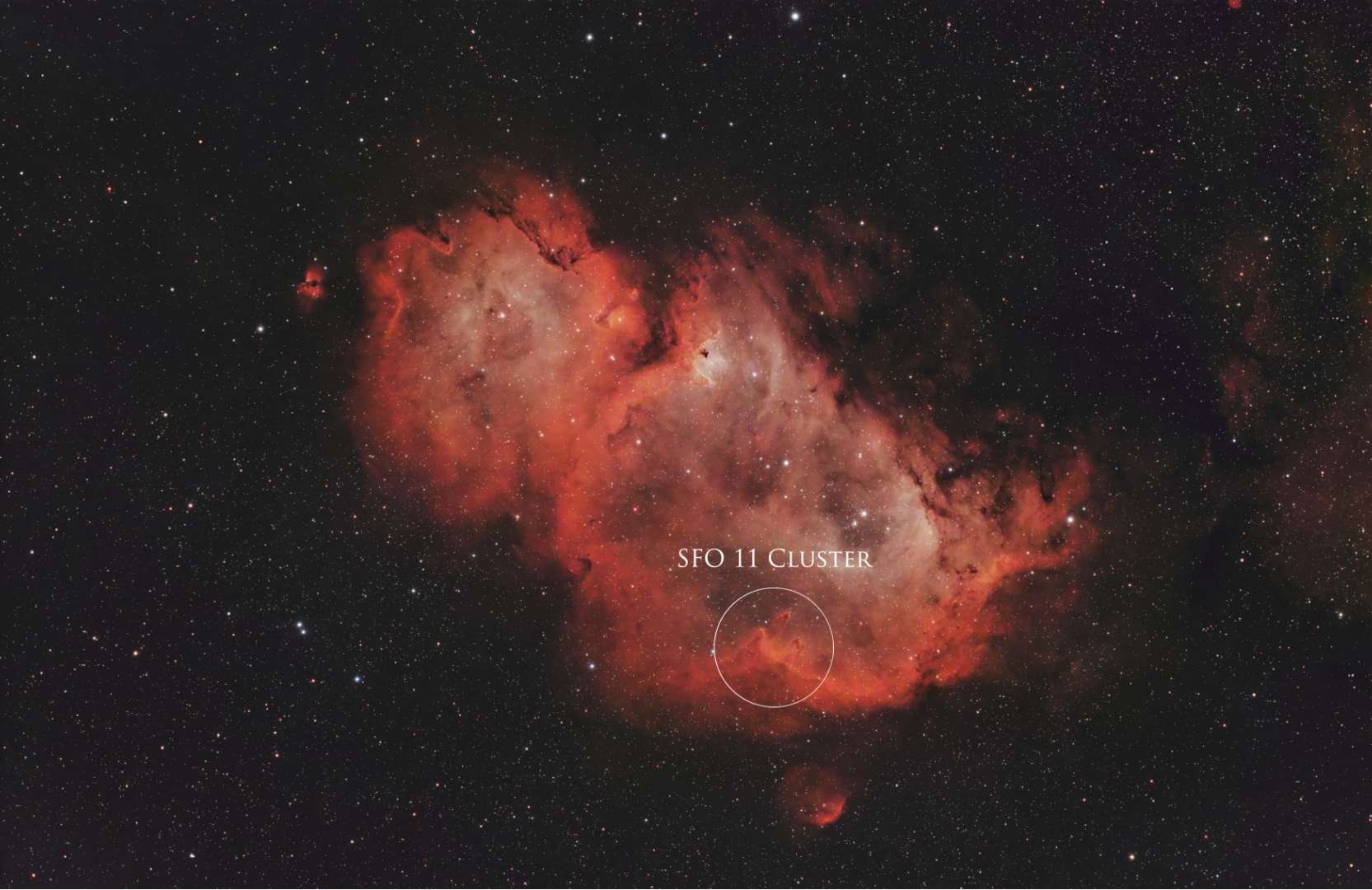
Star formation and star formation mechanisms, RDI theory in particular, have always interested me. IC 1848/ Westerhout 5 or the Soul Nebula (IC 1848 is the designation of the open cluster and not the nebula) contains many star forming areas but SFO 11 (Sugitani, Fukui and Ogura 11) and the adjacent cometary globules (often referred to as Bright-Rimmed Clouds (BRC) are some of the best studied. I was very surprised at the detail of this region I was able to capture with my recent image.


I've included a link to an paper by Thompson, White, Morgan, Miao, Fridlund, Huldtgren-White titled "Searching for signs of triggered star formation toward IC 1848" which presents evidence to confirm the process of RDI in forming the globules and associated star formation. The paper also presents clear evidence of photoevaporated flow (the primary process of molecular excitation in virtually all emission nebulae). Key tables are Table 4, flux analysis, table 5, temperatures and mass and table 6, central velocities. Section 3.4.2 is also worth a read as CO measurements were used to establish the temperature and density of the molecular clouds. If you just want a summary of the mechanisms at work then jump to section 3.6 and read the first two paragraphs.


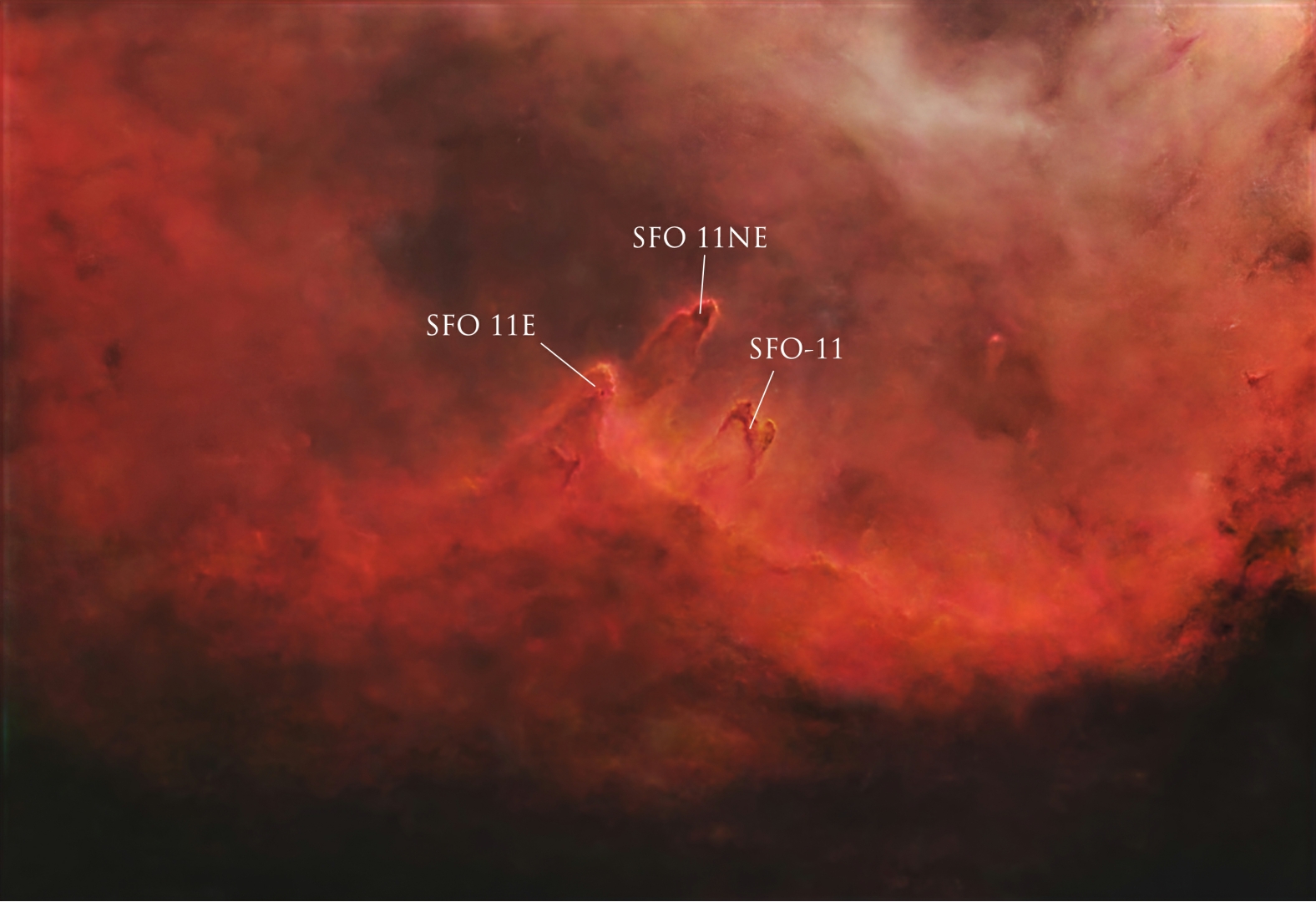
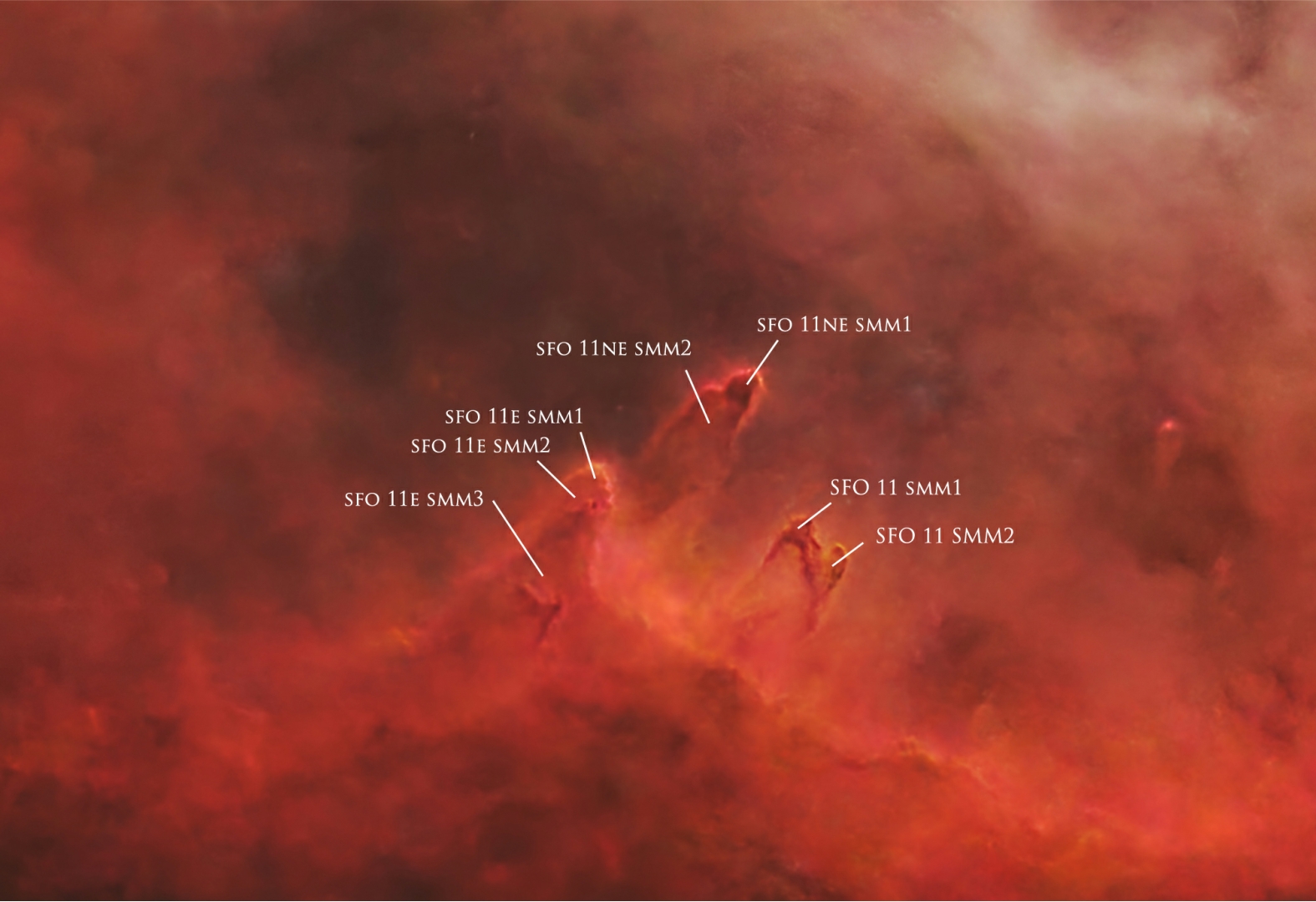
I think it's worth nothing that since this paper was first published in 2004, there have been at least 7 other papers detailing the same mechanisms at work in other star forming galactic nebula, including the Great Orion Nebula. SFO 11 NE SMM1 has been the subject of much recent study relating to motions associated with its core, which indicate a collapsing core surrounded by an expanding outer envelope, typical of re-expansion associated with RDI. The images below indicate the positions of the SFOs referenced in the article.


https://www.aanda.org/articles/aa/pdf/2004/06/aah4521.pdf


If you're interested in understanding a little more about photoevaporation flow, the process by which gas clouds are excited by UV and X-Ray radiation (where a gas cloud surface is ionized creating an expanding ionized front that acts as a barrier between hot, ionized gas and the colder molecular cloud), then "Photoevaporation Flows in Blister H II Regions. I. Smooth Ionization Fronts and Application to the Orion Nebula" by Henney, Arthur and García-Díaz, 2005, is well worth a read:


https://iopscience.iop.org/article/10.1086/430593/pdf


Or Radiation-Driven Implosion (RDI), "Radiation Driven Implosion and Triggered Star Formation" by Bisbas, Whitworth, Wünsch, Hubber and Walch, April 2011. – this is a short, but good paper, or:


https://articles.adsabs.harvard.edu/pdf/2011IAUS..270..263B


"A radiation driven implosion model for the enhanced luminosity of protostars near HII regions" by Motoyama, Umemoto and Shang, 2007


https://arxiv.org/pdf/astro-ph/0702332


SFO 11 Cluster.jpg

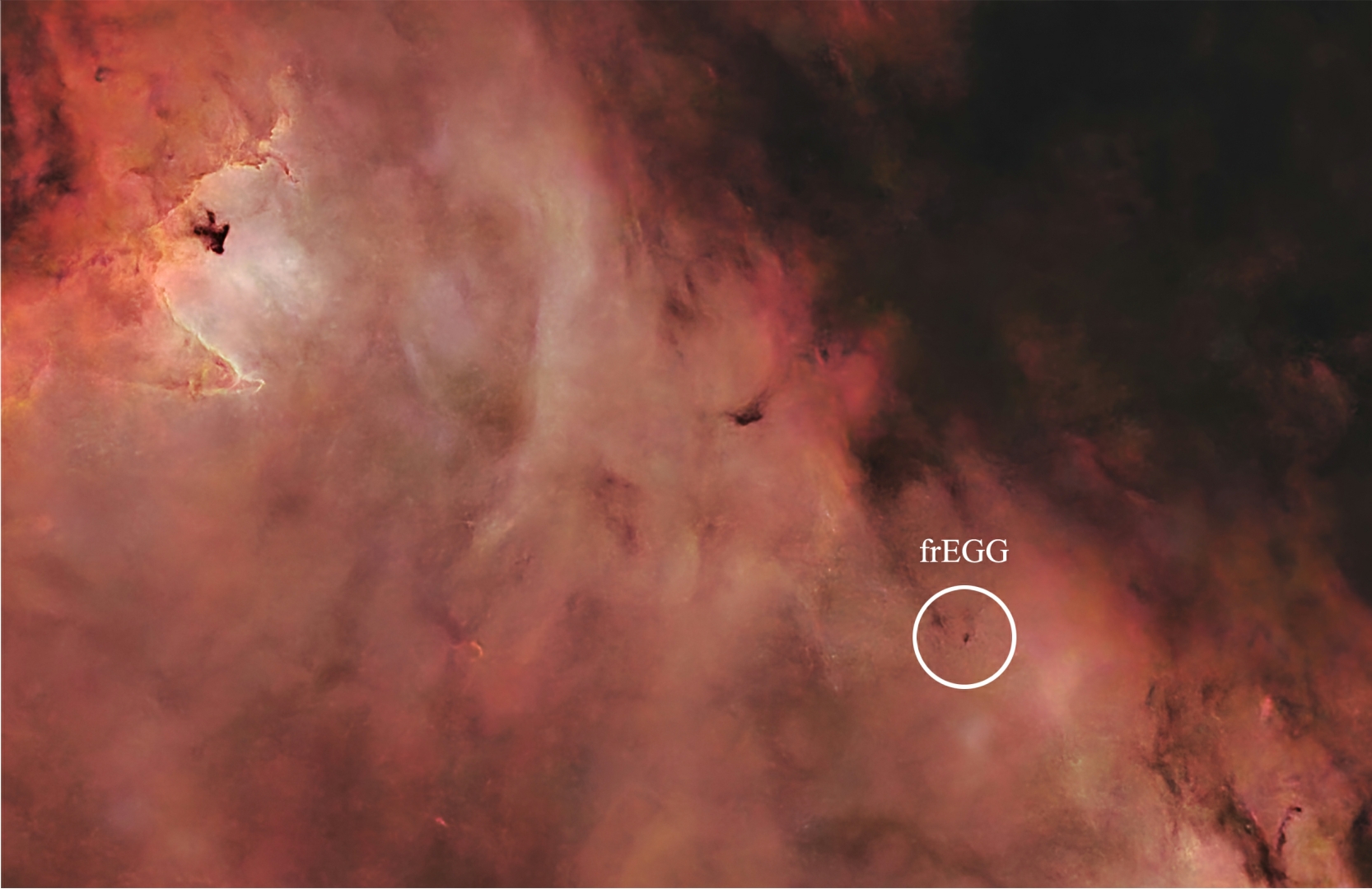
Evaporating Gas Globules (EGG).

Apart from the more obvious cometary globules, there are a number of other star forming processes going on within the Soul Nebula. The results of a survey undertaken by NASA using the HST, to locate Evaporating Gaseous Globules (EGGs) and Free-Floating Evaporating Gaseous Globules (frEGGs) was published in 2023 along with several images of such structures within the Soul nebula. EGGs are small, dense star forming molecular clouds within galactic nebulae, often subject to photoevaporative flow. Unfortunately I was only able to resolve one of these areas in my image. If you're interested in learning more about EGGs/frEGGs' then I recommend the paper by Raghvendra Sahai of JPL, 2017.


https://ui.adsabs.harvard.edu/abs/2017adap.prop..202S/abstract


Ultimately, all star formation is driven by gravity. Gravity is not a force, gravity is an effect, resulting from the interaction of mass and space-time as described by Einstein in his field equations, first presented to the Prussian Academy of Science in November 1915 and subsequently in his General Theory of Relativity published in Annalen der Physik, in 1916. While gravity is the primary mechanism behind star formation, a critical mass of material is required to begin with, and it is the mechanisms behind the accumulation and concentration of that material that form the basis of much research.


There are many mechanisms involved, from basic matter distribution, photoevaporative flow, Triggered or Radiation Driven Implosion (RDI), though Triggered formation includes many mechanisms, EGGs/ frEGGs etc. There are two papers that I'd like to point out. The first, by Kuruwita, Tychoniecb and Federrathc, 2024, is an examination of the nature of the forces that create stellar masses capable of start generation:


https://arxiv.org/pdf/2409.03371


The second paper, by Deepnil Ray, 2025, deals more with the terminal mechanisms of star formation.


https://papers.ssrn.com/sol3/papers.cfm?abstract_id=5169077.
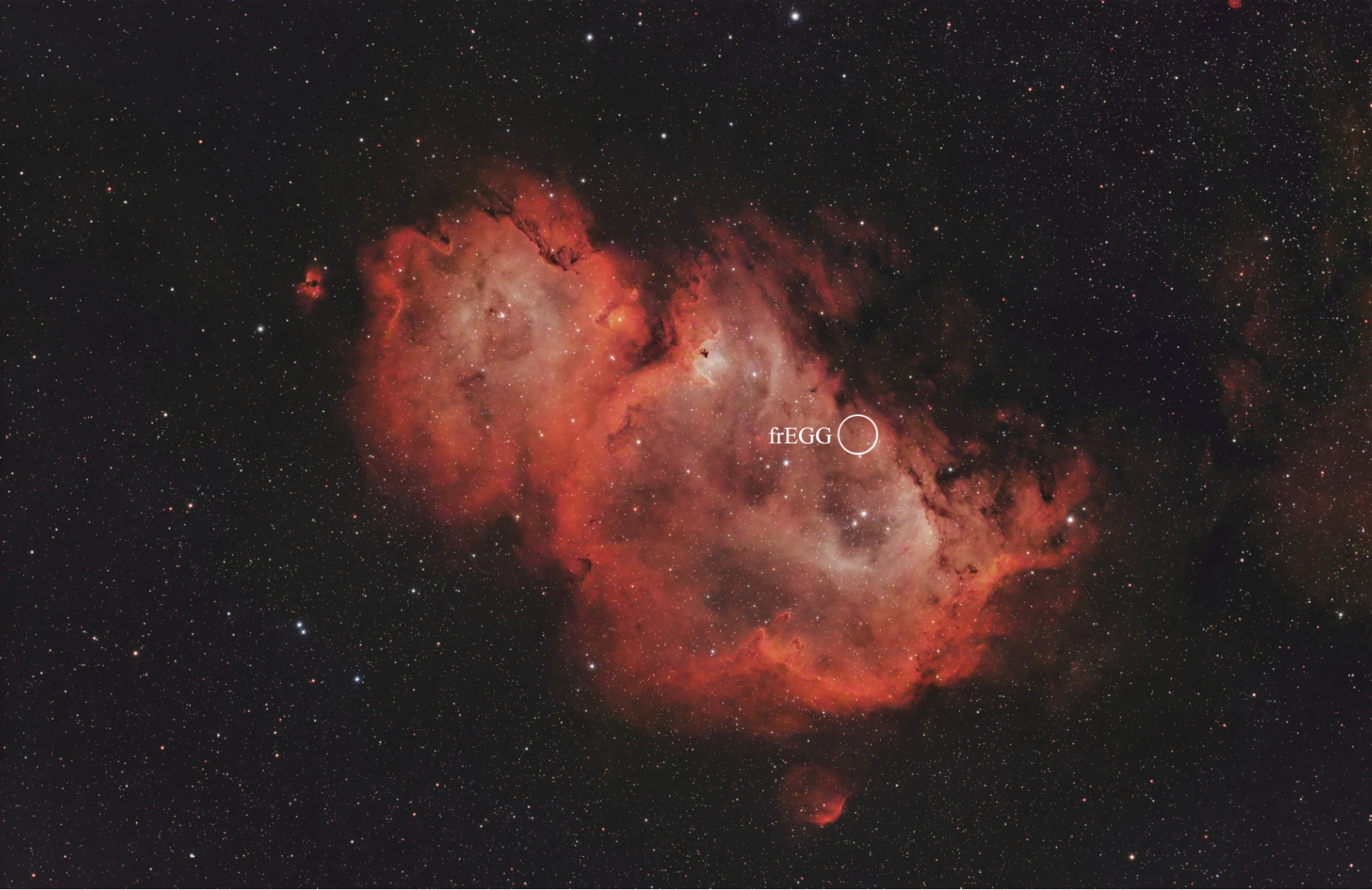
 

frEGG copy.jpg frEGG detail copy.jpg SFO 11 Ident copy.jpg SFO 11 SMMs copy.jpg